
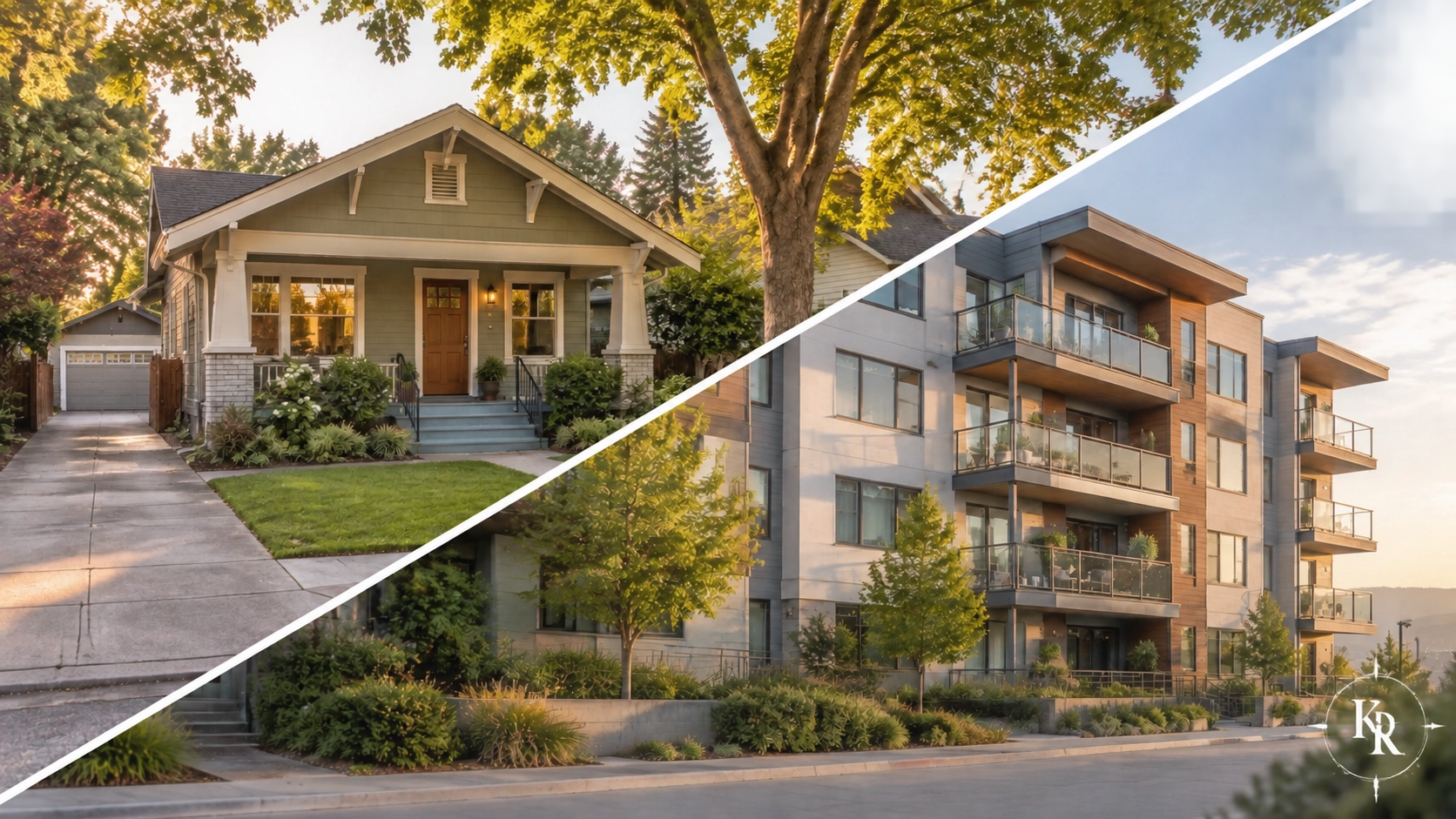
Choosing between a condo and a house in the East Bay is not simply a question of space. It is a decision about monthly cash flow, maintenance, flexibility, financing, and long-term equity.
In fall 2026, the market is giving buyers a clear choice. Detached homes remain relatively scarce and competitive, while condos and townhomes offer lower entry prices and more room to negotiate. Neither option is automatically better. The right fit depends on how you plan to live, how long you expect to stay, and how much financial responsibility you want to carry yourself.
Start with the local market reality
The August 2026 numbers show two distinct East Bay markets.
| Property type | Median price | Months of supply | Market position |
|---|---|---|---|
| Alameda County single-family homes | $1,269,000 | 1.9 | Seller’s market |
| Contra Costa County single-family homes | $865,000 | 2.4 | Seller-leaning |
| Alameda County condos | $562,500 | 4.1 | Buyer’s market |
| Contra Costa County condos | $444,950 | 4.0 | Buyer’s market |
| Oakland condos and townhomes | $410,000 | 3.1 | More balanced, buyer-leaning |
For additional market context, review Kindred Realty’s fall 2026 Oakland market reality check and the Maxwell Park Oakland neighborhood guide.
Detached homes are moving through a tighter supply environment. A well-priced, move-in-ready house can still attract multiple offers, particularly in desirable Oakland, Berkeley, Alameda, and inner East Bay neighborhoods. Condos generally give you more time to compare properties and negotiate terms, although a well-located unit in a financially healthy building can still draw strong interest.
The real cost comparison is more than the list price
A condo usually costs less to purchase, but the lower price does not tell the whole story. You need to compare the complete monthly and annual ownership costs.
Condo expenses to model
- Mortgage principal and interest
- Property taxes
- Homeowners insurance for the interior of the unit
- Monthly HOA dues
- Potential special assessments
- Parking, storage, or amenity fees
- Utilities not covered by the association
- Interior repairs and maintenance
Typical Oakland HOA dues are roughly $650 per month and up, although the amount varies widely by building. A newer building with elevators, secured parking, common insurance, staffed facilities, or extensive amenities may charge considerably more. A smaller association may have lower dues but fewer reserves and less capacity to absorb major repairs.
House expenses to model
- Mortgage principal and interest
- Property taxes
- Homeowners insurance
- Roof, foundation, plumbing, electrical, and HVAC maintenance
- Landscaping and pest control
- Exterior painting and drainage
- Seismic, wildfire, or other property-specific upgrades
Property taxes are often estimated at approximately 1% of assessed value, plus local assessments and other charges. Your actual bill will depend on the property, purchase price, tax rate, and applicable assessments. A house does not have an HOA in many cases, but you are responsible for every major system and repair.
That difference matters. With a condo, you pay for shared maintenance through dues and assessments. With a house, you control the decisions, but you also receive the repair bill directly.

How the price gap affects your monthly payment
Mortgage rates were around 7% for a 30-year fixed loan in late September 2026. At that rate, the price gap between a condo and a house has a substantial effect on the payment.
Consider an illustrative 20% down payment:
- An Alameda County condo at $562,500 would have an estimated loan of $450,000. Principal and interest would be approximately $3,000 per month.
- An Alameda County house at $1,269,000 would have an estimated loan of $1,015,200. Principal and interest would be approximately $6,750 per month.
- The difference in principal and interest is roughly $3,750 per month, before taxes, insurance, maintenance, and HOA dues.
In Contra Costa County:
- A $444,950 condo with 20% down would have an estimated loan of about $356,000 and principal and interest near $2,370 per month.
- An $865,000 house with 20% down would have an estimated loan of about $692,000 and principal and interest near $4,600 per month.
- The difference is roughly $2,230 per month before other ownership costs.
These are planning illustrations, not loan quotes. They exclude mortgage insurance, exact property taxes, insurance premiums, closing costs, maintenance, and special assessments. Still, they show why a condo may preserve more monthly cash flow even after adding a $650-plus HOA payment.
Ask your lender to compare both property types using the same down payment, rate, tax estimate, insurance assumptions, and cash-reserve requirements. The most affordable property is the one that remains comfortable after every recurring cost is included.
Condo financing requires deeper due diligence
A condo purchase can involve more financing variables than a detached home. The lender is evaluating not only your income and credit, but also the building and homeowners association.
Warrantable versus non-warrantable
A warrantable condo generally meets the guidelines used by conventional mortgage programs. A non-warrantable condo may have issues such as excessive investor ownership, significant commercial space, unresolved litigation, inadequate reserves, or unusual ownership structures.
Non-warrantable does not always mean impossible to finance. It can mean fewer lenders, higher down-payment requirements, higher rates, or more complicated underwriting. Confirm the building’s financing status early rather than after you have invested time and money in the transaction.
HOA documents and reserves
Your review should include:
- Current budget and financial statements
- Reserve study, if available
- Master insurance policy and deductible
- Recent meeting minutes
- Pending or proposed special assessments
- Litigation involving the association
- Rental caps and lease restrictions
- Owner-occupancy and investor-ownership percentages
- Maintenance responsibility for roofs, windows, balconies, plumbing, and exterior systems
- Seismic retrofit history or planned work
A low HOA fee is not necessarily a bargain. If dues have been kept artificially low for years, the building may be postponing necessary repairs. Strong reserves and realistic budgeting are often more valuable than the lowest monthly payment.
Which buyers tend to do better with each option?
A condo may suit you if you:
- Want a lower purchase price and smaller down payment
- Prefer a central or transit-oriented location
- Want less exterior maintenance
- Are comfortable with shared rules and governance
- Expect to stay at least several years
- Value predictable common-area maintenance
- Want more negotiating leverage in the current market
A house may suit you if you:
- Need multiple bedrooms, a yard, parking, or storage
- Want control over renovations and property decisions
- Prefer not to share walls or common areas
- Can maintain a substantial repair reserve
- Plan to hold the property for a longer period
- Want greater exposure to land value and detached-home demand
A condo can be an excellent first purchase, downsizing option, or investment when the building is healthy and the location is strong. A house can provide more flexibility and long-term ownership control, but stretching for one can create financial stress that outweighs the benefits.
Negotiation leverage is different for condos and houses
Attached properties currently offer more room for negotiation in many East Bay submarkets. You may be able to request a price reduction, closing-cost credit, interest-rate buydown, repair credit, or additional time to review HOA documents.
That leverage is strongest when a condo has been on the market for several weeks, carries high dues, has dated finishes, or belongs to a building with a complicated history. The opportunity is real, but the reason for the slower sale still needs to be investigated.
Detached homes require a more property-specific strategy. A house with deferred maintenance may provide negotiating room, while a turnkey home with a functional floor plan and desirable location may remain competitive despite higher rates. Review comparable sales carefully and set your maximum price before emotions take over.
For neighborhood-level context, the Oakland neighborhood guide can help you compare housing patterns, amenities, and lifestyle considerations across the city.
Think about resale and equity over time
Detached homes have generally shown stronger price resilience than condos in the 2026 East Bay market. Land is scarce, and buyers often place a premium on private outdoor space, parking, expansion potential, and control over the property.
That does not mean every house will outperform every condo. A poorly located or heavily deferred house can underperform, while a well-maintained condo near transit, employment, restaurants, and services may be highly desirable. Building quality and location matter greatly.
Your expected holding period is important. If you may sell in three years, transaction costs and slower condo resale could affect your outcome. If you plan to stay for seven, ten, or more years, both property types may provide time to build equity through principal reduction and market appreciation. A longer horizon also gives you more opportunity to absorb short-term price volatility.
A practical condo-or-house checklist
Before choosing, answer these questions honestly:
- What monthly payment feels comfortable, not merely approvable?
- Have you included HOA dues, taxes, insurance, and maintenance?
- How much cash will remain after closing?
- Are you comfortable with shared rules and association decisions?
- Will the property meet your space and lifestyle needs for several years?
- Have you reviewed reserves, insurance, litigation, and pending assessments?
- Is the condo warrantable for your intended loan program?
- Would you rather manage repairs yourself or share responsibility through an HOA?
- How might the property perform when you eventually sell?
- Are you choosing based on the property’s fit or simply its lower price?
The best decision is not always the house. It is the property that supports your budget, lifestyle, and long-term plans without leaving you financially stretched.
If you are ready to compare actual options, you can search current East Bay properties and then discuss the numbers, HOA documents, and negotiation strategy with a local advisor. You can also contact Kindred Realty for a thoughtful conversation about which path may fit your goals.
Market figures reflect the August 2026 East Bay snapshot provided for this article. Payments are illustrative only. Property taxes, insurance, HOA dues, assessments, financing terms, and maintenance costs vary by property. This article is for general educational purposes and is not financial, legal, tax, lending, insurance, or investment advice.